



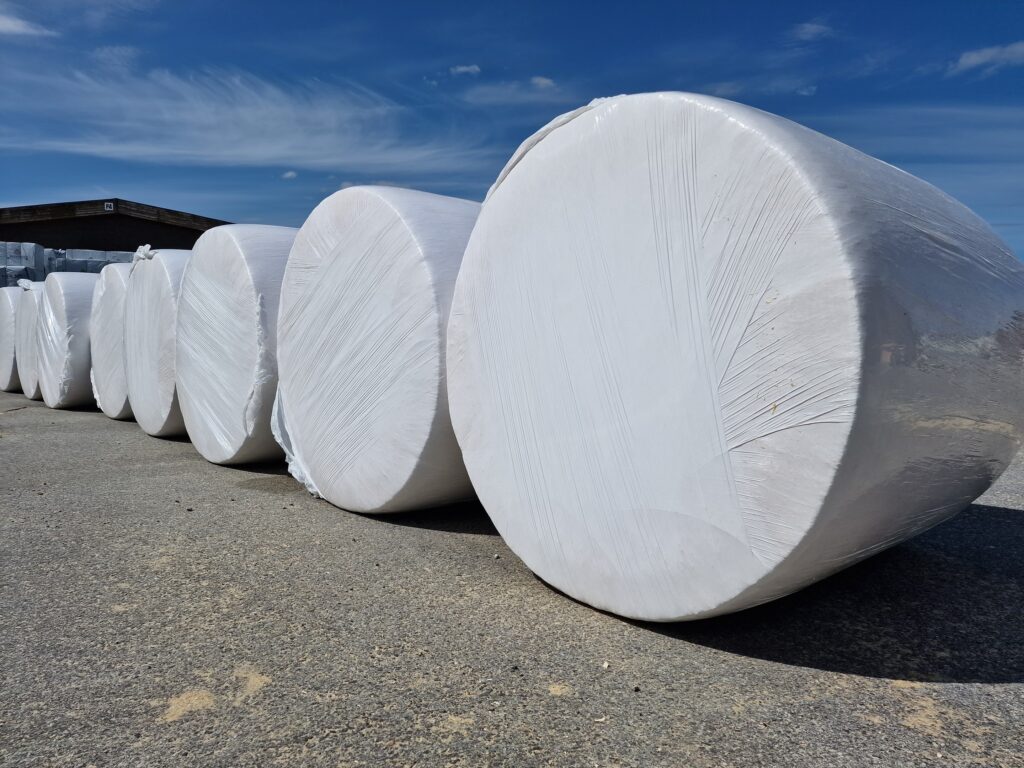
At Orkel, we pride ourselves on manufacturing machines that produce the highest density bales in the market. However, once that perfect bale leaves the chamber, its preservation relies entirely on one thing: the plastic wrapping.
If you use too little film or not the right quality, your forage will lose energy. Bacteria will digest the forage before you feed it to your livestock. If you use more than you need, the film costs go up.
We often get asked, “Which film should I use?” or “How much?” Even the best compaction technology cannot save forage if the oxygen barrier fails. To help you maximize the return on your baling investment, we have compiled a comprehensive guide on making the right film choices for your agricultural operations.
1. The Anatomy of a Good Film: What to Look For
Silage film is not just plastic; it is a technical barrier. When selecting a supplier, ensure the film is a multi-layer polyethylene (usually LLDPE) product—modern high-quality films often feature 3 to 7 co-extruded layers.
Key specifications to check:
• The Standard Width: For most modern round balers, including Orkel models, 750 mm is the industry standard width. 500 mm rolls are for smaller bales.
• Thickness (Microns): The standard thickness is 25µ (microns). However, “high-performance” films are now available in 19–23µ. Do not be fooled by the thinness; these technical films often offer equivalent puncture resistance and oxygen barriers to standard films but come with longer roll lengths.
• Roll Length & Efficiency: A standard 25µ roll is usually 1500 m long. The thinner, high-performance films can reach up to 1800 m or more. Why does this matter? Longer rolls mean less rolls to transport and fewer stops to change film, significantly increasing your daily baling output.
2. The Great Color Debate: Green, White, or Black?
For years, farmers chose film color based on brand preference or aesthetics, but research suggests color plays a functional role in feed quality.
• Light Colors (White/Light Green): These are generally the best choice for feed preservation. Light colors reflect sunlight, preventing the bale from overheating. Excessive heat can lead to butyric acid fermentation and nutrient loss.
• Black Film: While popular in cooler climates, black film absorbs heat. A study noted by agricultural experts compared green and black films; it found that bales wrapped in green film showed no spoilage, whereas bales wrapped in black film showed significant waste, particularly when fewer layers were used.
• Recommendation: Unless you are in a very cold region where heat retention is desired to aid fermentation, we recommend light green or white films to minimize temperature fluctuations and spoilage risk.
3. The “6-Layer” Rule (And When to Break It)
An important consideration is “How many layers are enough?”
If you use too little, your forage will lose energy. Bacteria will digest it before you feed it to you own animals. If you use more than you need, the film costs go up.
• The Golden Standard: Across the industry, 6 layers (2+2+2) is considered the minimum for reliable preservation. Polyethylene is not 100% gas-tight; it requires multiple overlapping layers to create an anaerobic environment. It also needs to be strong enough for handling and transport. Some studies suggest using 8 layers as standard, for even better forage conservation.
• When to Use More: If you plan to store bales for more than 12 months or the bales will be handled a lot, you should increase this to 8 or 10 layers. The extra cost of plastic is far lower than the cost of spoiled feed.
4. Wide Film (mantle film): The Net Replacement Revolution
Did you know Orkel was the first company to introduce a baler that could use wide film instead of net? We invented the wide film on bales around 20 years ago. It has now become the golden standard for most applications. (wide film, also called mantle flm, is the film put on inside the chamber, on the curved side of the bale).
Why Wide Film?
• Better Seal: It acts as an additional air barrier across the curved surface of the bale.
• Shape Retention: It holds high-density bales in a stable shape better than net. This is important. If the bale is not wrapped tightly enough, it expands a little after wrapping. That also means it sucks air into the bale, which is not good for conservation.
• Easy opening: Net might entangle and stick to the bale (especially in frosty conditions). Wide film slips more easily.
• Recycling Simplicity: Because the binding and the outer wrap are both made of the same material (polyethylene), you do not need to separate net from plastic when opening the bale. It is a “single waste” solution that simplifies recycling.
5. Storage and Handling: Don’t Ruin the Roll
Even the most expensive film will fail if mistreated before use.
• Store Upright: Always store film rolls vertically on their ends. Storing them horizontally can cause the roll to flatten (“egg-shape”), which leads to breaks and uneven tension during wrapping.
• Avoid sunlight for long time storage
• Chemical Warning: Keep film away from fertilizers, herbicides, and mineral oils. Chemicals can degrade the plastic structure rapidly, even before it is applied to the bale.
• The 30-minute Rule: Once the bale is ejected from the chamber, the clock starts ticking. Wrap your bales as quickly as you can to prevent air infiltration and ensure the fermentation process begins immediately. That is a good reason to use a baler-wrapper combination, compared to a single baler or a bunker silo.
6. Troubleshooting: The Stretch Factor
Finally, ensure your wrapper is calibrated correctly. The ideal pre-stretch for round bale silage film is generally 70%.
• Under-stretching: Wastes film and results in a loose wrap. If the bale is not wrapped tightly enough, it expands a little after wrapping. That also means it sucks air into the bale, which is not good for conservation.
• Over-stretching (Neck-down): If stretched too far, the film narrows (necks down), reducing the overlap width. If you don’t pay attention to this and adjust the overlap, this can create thin spots where oxygen can penetrate.
Summary Checklist
1. Choose Quality: Look for multi-layer, UV-stabilized film.
2. Select Light Colors: White or light green to prevent overheating.
3. Layer Up: Minimum 6 layers.
4. Consider Wide Film: For better density and easier recycling.
5. Store Correctly: Upright, cool, and away from chemicals.
Your Orkel baler is designed to create the perfect high-density package. By pairing it with the right film decisions, you ensure that the feed you take out is as high-quality as the crop you put in.